

Wind turbine components and their functions
The components of a horizontal-axis wind turbine are a rotor (blades and hub), a drivetrain (slow shaft, gearbox, fast shaft), a generator, and yaw, braking and pitch systems housed in the nacelle at the top of a tower. This page names these components, shows a few designs, and gives the cost breakdown of a wind turbine.
In this page:
1: Wind turbine components: from wind to generator
The world of wind turbines is dominated by the horizontal-axis machine, which has prevailed over vertical axes, notably on wear and maintenance. We therefore describe only the components of this type of turbine, without going into the detail of each.
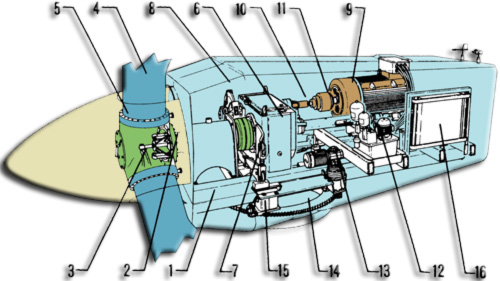
When the wind drives the blades (3), they turn the slow shaft (6), the gearbox (8), the fast shaft (20) and finally the generator (14). The gearbox is a train of gears, a true transmission, which carries the rotation of the slow shaft (6), at its input, to the generator's fast shaft (20).
A hydraulic unit (9), placed in front of the main axle, damps the yaw system, controls the automatic emergency stop and, where fitted, the blade pitch. Finally, a wind vane and an anemometer on the turbine provide the information needed to point it into the wind automatically.


The nacelle cutaway and its legend. The numbers cited in the text (3, 6, 8, 9, 14, 20) appear there: blades, slow shaft, gearbox, hydraulic unit, generator, fast shaft.
Here is another design, the Vestas V27, a 225 kW variable-pitch turbine of Danish technology:

The nacelle of a Vestas V27 in cutaway, with its legend. The gearbox (6) links the primary shaft (2) to the generator (9).
2: Small wind turbine components: the alternator
On the small wind turbines that follow, the rotor drives the alternator directly, without a gearbox. The first cutaway shows a blade fixed on a plate, in front of the alternator body.

A small wind turbine, exploded: the blade is fixed on a plate mounted on the alternator shaft.

The alternator in section: the stator, the two rotors, the bearings, the rectifier and the output cable.
A variant reverses the alternator. On its 1,500 watt model, Bergey Windpower places the permanent magnets inside a "magnet housing", on which the blades are mounted directly. The current flows through the stator coils, fixed to the flange of the main frame. The rotor bearing, between the stator and the housing, is a car wheel bearing.


A wind turbine with a reversed alternator and its legend: the magnets turn around the fixed stator.
3: Cost of wind turbine components: breakdown
The following breakdown gives the order of magnitude of each component's share in the cost of a wind turbine. The percentages are those we report here without a specific source; they add up to 100%.
- Blades: 12%
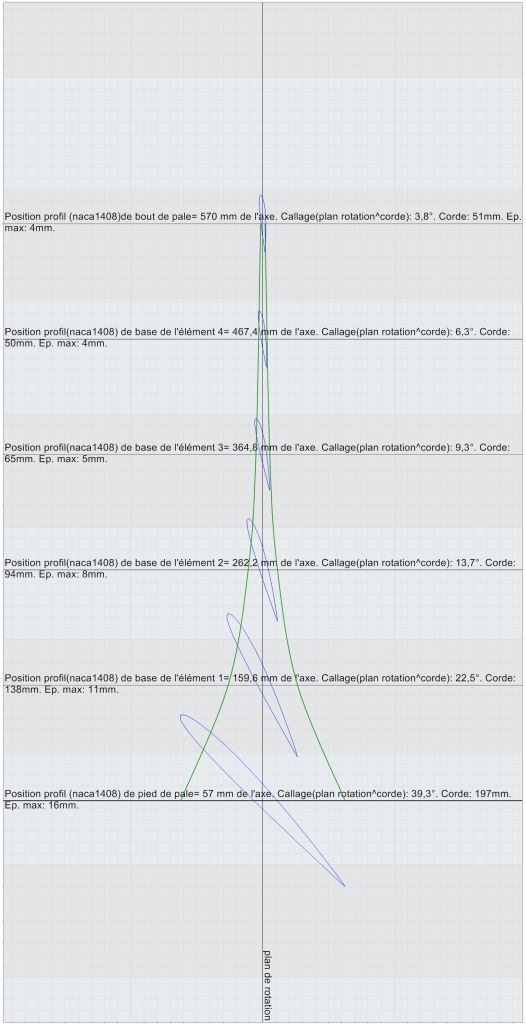
The drawing of a blade, from root to tip: the pitch angle goes from 39.3° at the root to 3.8° at the tip, and the chord from 197 to 51 mm. The profile is a NACA 1408 at every station.
- Hub: 2%

- Gearbox: 15%


A sectioned planetary gearbox, and a parallel-shaft gearbox.
- Generator: 13%

- Bearings: 3%

- Hydraulic unit: 10%
- Electrical: 8%
- Nacelle: 9%
- Assembly: 2%
- Miscellaneous: 5%
- Tower: 21%
To go further, we can look at how the wind turbine generator works, the wind turbine blade drawing or the construction of a wind turbine.
 Global site map
 Mecaflux
 Tutorials Mecaflux Pro3D
 Tutorials Heliciel
 Tutorials Heliciel PRO CFD
 Mecaflux Store
 Compare software functions
 Quotes, Orders, Payment Methods
 project technical studies